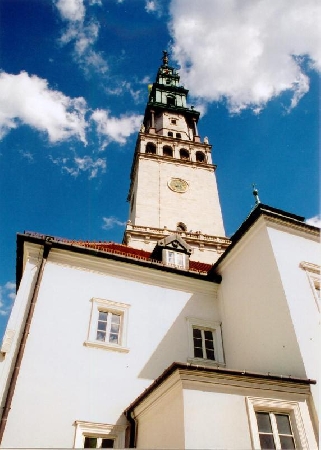
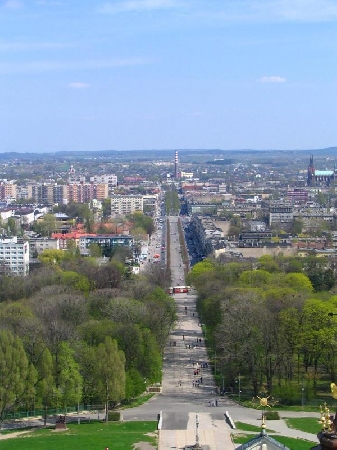
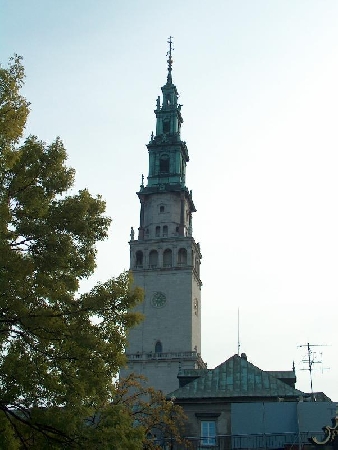
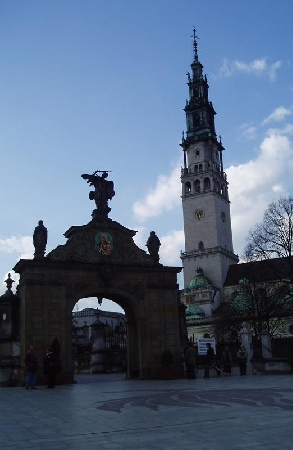
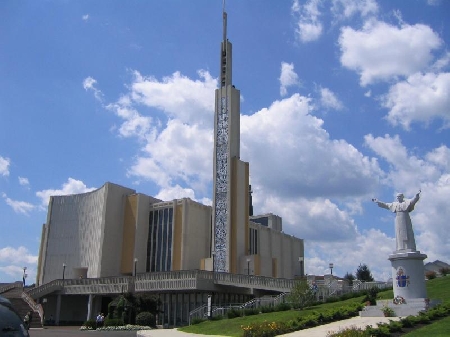
Czestochowa plays a crucial role for the Roman Catholic Poles, being a kind of spiritual capital to them. The cult status of the Jasna Gora monastery, one of the most important pilgrimage destinations of the Christian world, has been growing along with the distinguished history of the site. It has become a symbolic mainstay of Polish identity and the Roman Catholic religion, as the hill of Jasna Gora was besieged by Swedes, Russians and Germans, who were all of different faiths.
The shape of the city Czestochov came about through the joining of two parts: of Czestochov village in back of the “Jasna Gora” and of old Czestochov which lies by the river Varta. Both parts developed separately. Old Czestochov already existed in the year 1377. In the year 1502, King Alexander, on the basis of the Magdeburg Law, gave Czestochov the rights of a city. Czestochov again until the second half of the 17th century belonged to the Olsztyn county. After the Congress of Vienna (1815), both parts of the city fell under Czarist rule. Both parts of the city continued to grow territorially and gradually neared each other. In the year 1826, both parts united and became one city. In the year 1867, Czestochov became the capitol of the county
Czestochowa (pronounced Chenss-toh-hoh'-va) is a city in Poland that is home to the nation's most important religious relic: the Black Madonna. The Black Madonna is a centuries-old icon depicting the Virgin Mary with two scars on her face. The icon is attributed to miracles and is displayed on a Baroque alter in a chapel in Jasna Gora monastery.
Częstochowa (prononciation : ]) est une ville méridionale de Pologne située dans la voïvodie de Silésie dont elle est la deuxième plus grande ville. Elle est connue dans le monde entier par le monastère des Pères Paulins à Jasna Góra de l'image miraculeuse de la Vierge de Częstochowa, l'icône de la Madone Noire. Les pèlerins ont fait de Częstochowa l'un des centres majeurs de pèlerinage dans le monde. Le sanctuaire est visité en moyenne par 4 à 5 millions de pèlerins qui viennent de 80 pays du monde, dont plus de viennent à pied. Les trajets les plus longs font plus de et prend une vingtaine de jours.
Le climat est toujours propice. La ville est un grand centre à l'infrastructure bien développée et un important arrière-pays socioéconomique. C'est une ville académique qui compte neuf écoles supérieures dans lesquelles étudient plus de quarante mille étudiants. C'est un centre de culture, qui puise dans la tradition et l'histoire. C'est aussi une ville ouverte au monde. Une splendeur particulière lui a permis, en 1998, d'être la première ville de Pologne à recevoir le Prix de l'Europe par le Conseil de l'Europe.
La ville est le chef-lieu du Powiat de Częstochowa ainsi que du Powiat-Ville de Częstochowa.
Description above from the Wikipedia, licensed under CC-BY-SA full list of contributors
here.