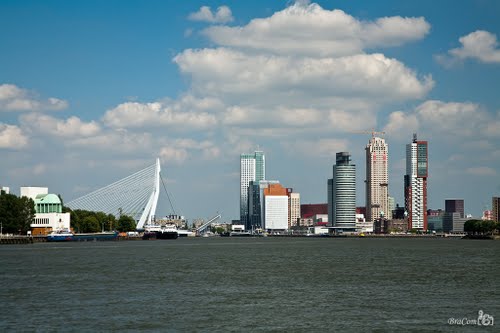
Rotterdam is a municipality and city in the Dutch province of South-Holland, situated in the west of The Netherlands and part of the Randstad. The municipality is the second largest in the country (behind Amsterdam), with a population of approximately 600, 000 people. The city has 1. 3 million inhabitants in its metropolitan area.
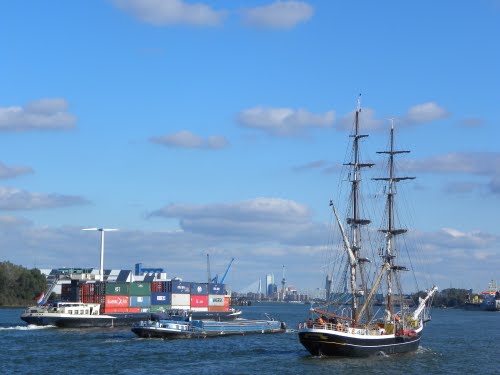
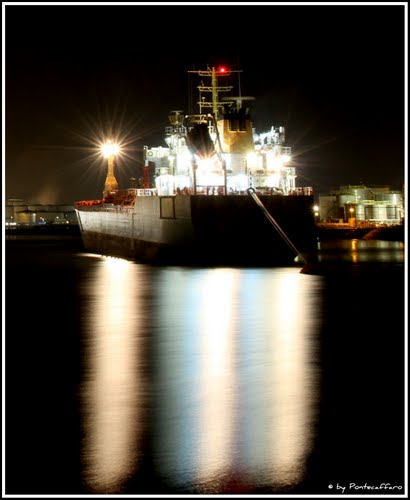
The port of Rotterdam is the largest in Europe. From 1962 to 2004, it was the world's busiest port; then it was superseded by Shanghai.
Although Rotterdam did well after the middle ages and in the 'Golden Century' - roughly between 1650 and 1750) it was not before the second part of the nineteenth century that the city started to develop itself rapidly. Helped by the digging of a new seaway (The Nieuwe Waterweg) Rotterdam was rid of acces problems caused by the silting of the river and started receiving ever bigger ships with cargo for/from the booming Ruhrgebiet in Germany. Port related trade and industry skyrocketed, and the city started to draw lots of migrants from the then poor Brabant province, for whom the southern part of the city was constructed. At the turn of the twentieth century Rotterdam was well under way to become the largest economic centre in The Netherlands. It was between then and the second world war that large prestigious construction works were undertaken, in part to show off the new found economic pride.
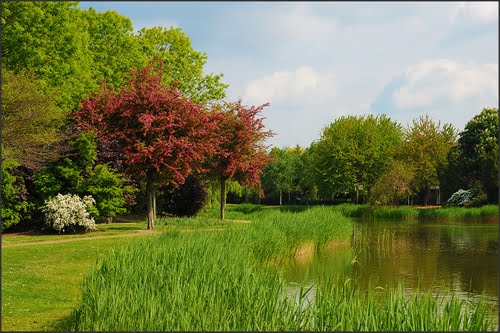
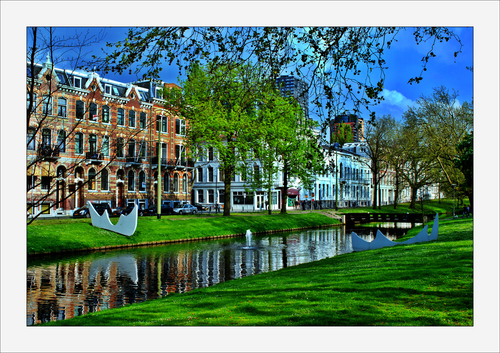
One may also find that visiting this city in spring or summer time is more enjoyable than in winter time, as the Netherlands can be a rainy place and Rotterdam is a city that especially gains a lot of charm when the sun is shining.
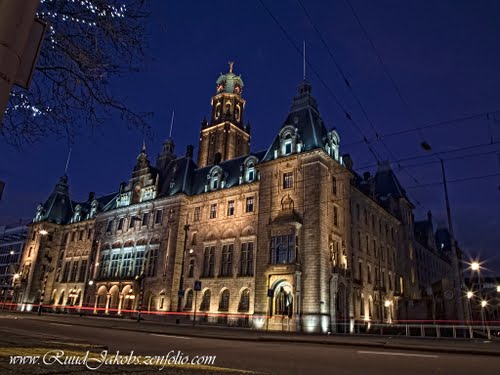
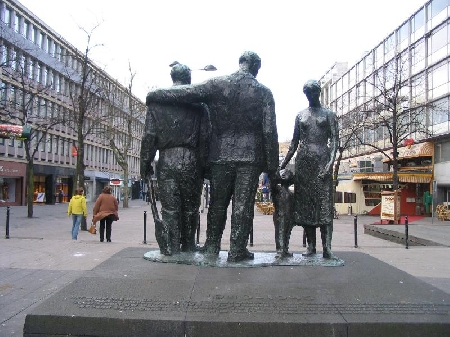
City Hall, Coolsingel 40 (Metro: Stadhuis). Mon-Sat: 8:00-17:00. Rotterdam City Hall was built in 1914 in a somewhat exuberant Art Deco style. Erasmus Statue, Grotekerkplein (Metro: Stadhuis or Blaak). The statue of Desiderius Erasmus of Rotterdam stands opposite the Grote of Sint Laurenskerk. De Verwoeste Stad Statue, Plein 1940 (Metro: Beurs). This statue, "The Destroyed City", by the Franco-Belarussian sculptor Ossip Zadkine dates from 1953. Sylvette, Westersingel (Metro: Eendrachtsplein). This large work by Pablo Picasso was erected in 1973. It is one of the elaborations Picasso made based on the portraits of his muse Sylvette David.
Rotterdam est une ville portuaire néerlandaise de habitants (environ dans l'agglomération). Son agglomération fait partie de la conurbation de la Randstad Holland ( habitants entre Amsterdam - Haarlem - La Haye - Dordrecht - Utrecht).
Rotterdam est la seconde ville des Pays-Bas après Amsterdam. Elle représente le cœur industriel des Pays-Bas, et jouit d'une position géographique stratégique, à l'embouchure du Rhin et de la Meuse et proche du pas de Calais séparant Manche et Mer du Nord. Elle est ainsi le débouché économique de toute l'Allemagne de l'ouest, la région la plus dynamique d'Europe.
Son activité est donc principalement maritime, elle possède des infrastructures portuaires sur près de 30 kilomètres.
La capacité et la modernité de celles-ci lui permettent le quasi monopole des arrivées d'hydrocarbures en Europe (Rotterdam et le Havre sont les seuls ports de la côte atlantique à pouvoir accueillir des super tankers pouvant transporter jusqu'à tonnes de pétrole) et elle est aussi un point important pour les matières premières et les conteneurs.
Cet ensemble lui a permis de s'affirmer comme le quatrieme port mondial (et le premier port européen), malgré la concurrence croissante de Shanghai et Singapour qui l'ont largement dépassé pour le transbordement de conteneurs.
Le port est néanmoins vulnérable à la montée des océans et à d'éventuelles ruptures de digues de polders. Il fait pour cette raison l'objet d'études prospectives approfondies et d'un nouveau Plan Delta dit « Deltawerken 2 » (le premier ayant fait suite aux inondations des années 1950)
Description above from the Wikipedia, licensed under CC-BY-SA full list of contributors
here.